
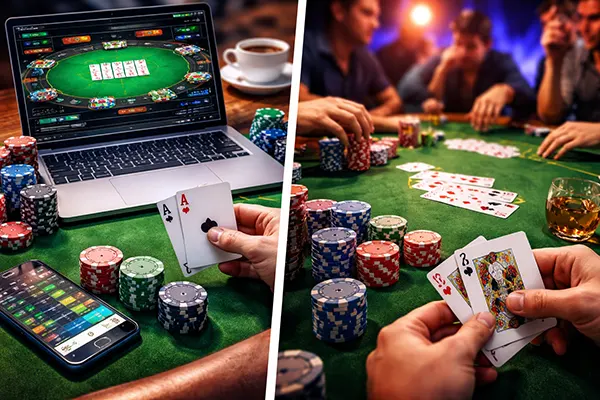
Why Online Poker Is Perceived as More Complex Than Live Poker
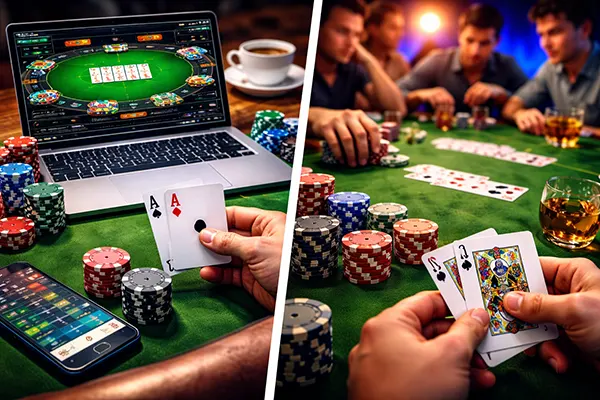
At first glance, poker appears to follow the same core rules regardless of where it is played. The hand rankings remain unchanged, betting structures are familiar, and the objective is always to make better decisions than opponents. Yet many players consistently describe online poker as more difficult and mentally demanding than live poker. This perception is not accidental and is rooted in structural, psychological, and technical differences between the two formats.
The impact of game speed and decision density
One of the most noticeable differences between online and live poker is the pace of play. Online tables deal far more hands per hour, often exceeding 70–90 hands compared to 25–30 in a physical card room. This higher frequency compresses decision-making into shorter timeframes, leaving little room for hesitation or extended observation.
Because decisions occur more often, mistakes accumulate faster. A single lapse in concentration online can affect dozens of hands within minutes. In contrast, live poker naturally provides pauses that allow players to reset mentally, reconsider previous actions, and recover from errors more gradually.
The increased volume also raises variance. Even skilled players can experience longer downswings online due to the sheer number of hands played. For many, this creates the impression that online poker is less forgiving and more punishing than its live counterpart.
Time pressure and reduced emotional recovery
Online poker imposes strict time banks for each decision. Players must process hand ranges, stack sizes, position, and opponent tendencies quickly, often under visible countdown timers. This constant pressure can lead to rushed judgments, especially for less experienced players.
Unlike live environments, there is little opportunity to step away between hands. Emotional reactions such as frustration or overconfidence can immediately influence subsequent decisions, increasing the risk of tilt. Managing emotional discipline therefore becomes a technical skill rather than a situational one.
As a result, many players perceive online poker as mentally exhausting. The need to remain focused for extended sessions without natural breaks contributes strongly to its reputation as a more complex format.
Limited physical information and reliance on data
Live poker provides a wide range of physical cues, from betting posture to facial expressions and timing patterns. Even subtle changes in behaviour can offer valuable insights. Online poker removes nearly all of these signals, forcing players to operate with incomplete sensory information.
Instead of visual tells, online players must rely on betting history, timing tells, and statistical tendencies. This shift demands a more analytical mindset and stronger pattern recognition skills, especially when facing unfamiliar opponents.
For players transitioning from live games, this absence of physical context often feels like playing with fewer tools. The game appears colder and more abstract, reinforcing the idea that online poker is inherently more complex.
The role of tracking software and statistics
Modern online poker is heavily influenced by tracking software that records hand histories and generates detailed statistics. Concepts such as VPIP, PFR, and aggression frequency are widely used to evaluate opponents and adjust strategies.
While these tools provide valuable insights, they also raise the entry barrier. Players who do not understand or correctly interpret statistical data may feel disadvantaged, even when playing fundamentally sound poker.
This data-driven environment transforms poker into a semi-analytical discipline. For many, the need to combine intuition with numerical analysis adds an extra layer of perceived difficulty not commonly encountered in live settings.
Player pool composition and strategic depth
Online poker attracts a global player base, leading to a much broader range of skill levels and playing styles at any given table. Recreational players, semi-professionals, and highly disciplined regulars often compete simultaneously.
This diversity increases strategic complexity. Adjustments must be made more frequently, as assumptions about opponent behaviour can change from one table to the next. In live poker, player pools are often smaller and more predictable.
The constant exposure to competent and technically trained opponents contributes significantly to the belief that online poker is tougher. Even at modest stakes, players may encounter strategies that are rarely seen in local live games.
Multitabling and strategic overload
Another factor unique to online poker is multitabling. Many players compete at several tables at once to increase volume and profitability. While effective, this approach demands exceptional concentration and decision-making efficiency.
Handling multiple hands simultaneously reduces the ability to reflect deeply on individual situations. Errors may go unnoticed, and learning becomes less intuitive compared to live poker, where focus remains on a single table.
For observers and newcomers alike, multitabling reinforces the image of online poker as a highly technical activity suited only to those who can manage complexity at scale.