

Why Some Casino Games Work Better in a Browser Than a Mobile App
A mobile app is often assumed to be the fastest way to play casino games on a phone, but that is not automatically true in 2026. Many modern slots, table games and live-dealer titles are built to run as web content, so the same game can appear inside a normal browser and inside an app that uses an embedded web view. In practice, the smoother option depends on how the casino has integrated the game, how current the software is, the phone’s available memory, the quality of the connection and the way the game supplier has optimised its content. That is why one title may open faster and run more consistently in Safari or Chrome, while another feels better inside the casino’s app on the very same device.
Why Browser-Based Casino Games Can Feel Smoother
Modern mobile browsers are capable of handling far more than simple pages. They can use the phone’s graphics hardware to draw animated reels, moving backgrounds, card tables and other visual effects without requiring a separate game installation. Technologies such as WebGL are supported by current browsers, while WebAssembly is widely available and can help web applications handle demanding calculations efficiently. Safari 26 also introduced WebGPU support on Apple devices, giving newer browser-based content another route to the phone’s graphics processor. A player does not need to understand these technologies to benefit from them: the practical result is that a well-built browser game can now feel much closer to native software than older mobile websites did.
There is another reason the browser can perform well: the casino app may not actually contain a separate version of the game. On iPhone and iPad, developers can display interactive web content inside an app through WKWebView. Android offers a similar WebView component based on Chromium. This means an app can provide native menus, account controls and login features while still loading the actual slot or live casino game as web content. When that happens, the difference between app and browser is less about the game itself and more about the way each environment handles the game window, memory, permissions, screen size and navigation.
Browser delivery also makes it easier for a casino or game supplier to serve an updated version of a title from its servers. A refreshed game can be loaded the next time the player opens it, without requiring the entire casino app to be replaced. Native app changes are different because new releases may need to be distributed through an app store and can be subject to review. That does not make browsers universally faster, but it can explain why a browser version receives a compatibility fix sooner or why an older app build behaves differently from the current casino website.
Why Heavy Slots and Live Casino Can Expose the Difference
Feature-rich slots are a useful example because they combine several demands at once. A modern release may include layered animations, expanding symbols, animated characters, multiple bonus sequences, sound effects and transitions between the base game and feature rounds. If the game has been carefully optimised for mobile browsers, Chrome or Safari can use hardware acceleration and keep those effects responsive. On a weaker or older phone, however, the same title may still slow down because no browser or app can remove the limits of the device’s processor, graphics hardware, available memory or thermal controls.
Live casino games create a different workload. The device has to display a continuous video stream while also updating betting controls, timers, results and table information. A strong browser implementation can handle this smoothly because modern browsers are designed for video playback and interactive web content at the same time. An app can do the same, but performance depends on how the live game has been embedded and how the app manages video, orientation and memory. If the app uses a web view for the live table, the player may be seeing essentially the same supplier content through a different container.
The difference can become more visible in casinos that bring together games from many suppliers. One slot may be lightweight, another may use more complex graphics, and a live table may rely heavily on streaming. A browser can load each supplier’s current web version directly, while an app has to present all of those game clients inside its own navigation and security setup. A well-maintained app can handle this perfectly well, but a poorly tuned one may introduce awkward resizing, delayed full-screen changes or extra loading steps that are absent when the game is opened directly in the browser.
Why a Mobile App Can Still Be the Better Choice
An app has advantages when the casino has invested in more than a simple wrapper around its website. Native account controls can make signing in, checking limits, confirming identity or moving between the cashier and game lobby feel more consistent. Some apps can also integrate device features such as biometric login, notifications and operating-system-level navigation more neatly than a browser page. These benefits do not necessarily make the actual game mathematics or graphics faster, but they can reduce friction before and after a gaming session.
An app can also be tuned for a narrower range of devices and screen behaviours. Developers may control how the phone handles portrait and landscape modes, full-screen presentation, audio interruptions and transitions between the game and account areas. The app can keep certain interface resources locally, which may make menus and repeated visits feel quicker. If the casino has optimised these parts carefully, the overall experience can feel more stable even when the game itself is loaded from the same supplier servers used by the browser version.
There is also a practical difference in how people use their phones. Browser tabs can be closed accidentally, reloaded after memory pressure or lost among many other open pages. A dedicated casino app gives the service its own icon, its own recent-app entry and a more contained route back to the account. This can make returning to the lobby easier. It is still important to separate interface convenience from the rules of a game. A browser and an app can sometimes launch different certified versions or configurations of the same title, so players should check the in-game information rather than assume the RTP is identical. At the same time, the display route by itself should not be treated as something that changes a random result or makes a game more favourable.
When the App Version Is More Likely to Win
The app is more likely to feel better when it has been designed specifically for regular mobile use rather than created as a thin shell around the website. Fast biometric sign-in, clear full-screen controls, reliable orientation changes and sensible handling of interruptions can make a noticeable difference during repeated sessions. A player who uses the same casino frequently may value those details more than the small difference in initial loading time between the app and browser.
The app can also have an advantage when the browser is outdated, heavily restricted or affected by extensions and settings that interfere with game content. Content blockers, strict privacy settings, disabled cookies or an old browser build can prevent some login, payment or game-launch functions from working as intended. On Android, the system WebView used by many apps is based on Chromium and is updated separately from the Android operating system, so a current app and a current browser may perform very similarly. In this situation, the deciding factor is often configuration rather than the general idea that apps are faster.
Availability is another consideration for real-money casino apps. Apple requires real-money gaming apps to hold the necessary licences and permissions, restrict use to authorised locations and remain free to download. Google Play also limits real-money gambling apps to approved, licensed operators in eligible countries and requires controls for age and location. These rules can affect where an app is offered and what it can include. Browser access is still subject to gambling law and the operator’s licence, but the website and the store-distributed app are separate delivery routes, so a legal casino may not offer both in every market.
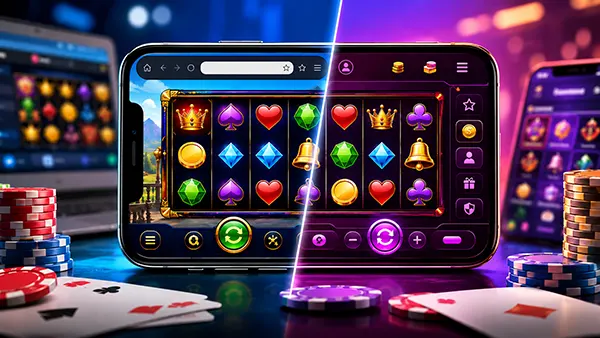
How to Choose the Better Option on Your Device
The most useful test is to compare the same game under the same conditions. Open it in the official casino app and then in an up-to-date browser while using the same phone and the same Wi-Fi or mobile connection. Compare the time taken to reach the playable screen, the smoothness of reel or card animations, the response of buttons, audio synchronisation, full-screen behaviour and how quickly the game reconnects after a brief interruption. A difference that appears consistently across several launches is more meaningful than a single slow load caused by temporary network congestion.
Basic maintenance matters more than many players expect. Keep the operating system, browser and casino app current, and avoid running a large number of demanding applications in the background when the phone has limited memory. If one game suddenly becomes unstable, restarting the browser or app is a sensible first step; clearing stored site data should be reserved for persistent problems because it can sign the user out and remove useful cached files. Connection stability also matters, especially for live casino streams, so switching repeatedly between Wi-Fi and mobile data during a session can create interruptions even when the game software itself is working correctly.
Security and licensing should come before a small performance advantage. Use the casino’s official website and, where an app is available, obtain it through the operator’s verified route or the recognised app store for the device. Check the operator and licence information against the relevant gambling regulator rather than treating an app-store listing as proof on its own. Real-money apps on Apple and Google stores face licensing and location requirements, but players should still confirm that the casino is authorised for their country. A faster game is not a useful trade-off if the service itself is not properly licensed.
A Practical Rule for Browser Versus App
If the same casino game opens faster, stays stable and responds cleanly in a browser, there is no technical reason to install an app merely because apps are assumed to be superior. Browser technology in 2026 is strong enough to run sophisticated graphics, audio and streaming on modern phones, and many casino games are created with web delivery in mind. For players who prefer not to install extra software, a well-optimised mobile website can therefore be the simpler choice without giving up game quality.
If the app provides quicker sign-in, cleaner full-screen play and more reliable movement between games and account functions, using the app makes equal sense. The comparison should focus on the actual titles a player uses, not only on how quickly the casino home screen opens. A lightweight slot, a graphics-heavy slot and a live table can behave differently because they place different demands on the device and may come from different suppliers.
The main point is that browser versus app is no longer a simple contest between a slow website and fast installed software. In many cases, both routes are displaying web-based game technology, and the quality of the implementation matters more than the icon used to open it. Browsers often perform especially well with current HTML5 casino games and multi-supplier catalogues, while a carefully built app can offer a smoother overall mobile experience through better device integration. Testing both on the same phone is the most reliable way to decide which option works better.